By Stuti Mankodi
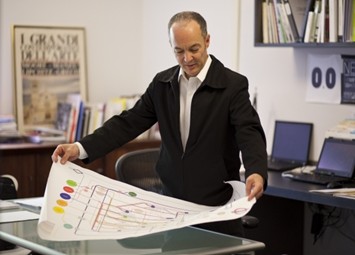
Penn Professor Bill Braham
Professor William W. Braham is the Andrew Gordon Professor of Architecture and Director of the Center for Environmental Building + Design in Penn’s Weitzman School of Design and a leading voice in environmental building design and systems ecology. Trained as both an engineer and an architect, his work bridges architecture, energy systems, and ecological thinking, challenging students and practitioners alike to reconsider how buildings operate within larger urban and environmental systems. In this conversation, Professor Braham reflects on bioclimatic design, systems thinking, and the opportunities and challenges facing sustainable architecture today.
Can you briefly describe the focus of your work in architecture and environmental building design, and what drives your research interests?
On the one hand, it’s a pretty easy answer: my focus is buildings. I’m an architect—architects focus on buildings.
For the last 15 or 20 years, that focus has really taken two directions, which align closely with the courses I teach in the Environmental Building Design program.
One is bioclimatic design: How do you make buildings work better with their climate? We’ve shown over the years that if you design a building well, i.e., how you make it, what you make it out of, and critically, how it responds to climate, you can make buildings comfortable 80–90% of the time in most climates. That might mean opening windows when it’s cooler outside than inside, or shading windows when there’s too much sun. It’s really dramatic, what’s possible. Teaching students how to do that, and continuing to research and write about it, has been a major focus.
The second direction is the bigger question: How do buildings fit not just into natural ecosystems, but into the complex, self-organizing urban systems within which we find ourselves? Early in my career, especially during the energy crises of the 1970s, everything was about energy. Over time, I realized it isn’t all about purchased fuels, but about all the work and resources that go into a building. Understanding that larger ecological and systemic picture has become central to my research and teaching. Those questions drew me to systems ecology, which is a holistic approach to ecology developed originally by H.T. Odum, which draws on thermodynamics and general systems theory to develop principles of self-organization in systems of all kinds.
What initially drew you to sustainable architecture and environmental building design, especially the integration of energy and ecology into architectural practice?
Like many architects, I decided I wanted to be an architect when I was about 12. By high school, I was already taking architecture courses.
I remember seeing an intentionally designed solar building in Taos, New Mexico, and thinking, this makes so much sense. The architecture itself was doing the work! It wasn’t relying entirely on HVAC equipment. That was incredibly compelling.
This was during the energy supply crises of the 1970s, so by the time I went to college, energy was at the center of the conversation. I studied engineering at Princeton, where the Center for Energy and Environmental Studies brought together engineers, architects, psychologists, and economists. It was an exciting moment, because physicists who had worked on nuclear projects were suddenly turning toward solar energy.
For at least a decade after that, my focus was very much on energy. But over time, especially in the early 2000s, I revisited the work of systems ecologists like Howard Odum and began thinking more holistically. Energy is important, but it’s important in many more ways than fuel cost or scarcity. Ecology provided a way to understand not just fuel use, but how buildings fit into broader systems of production, consumption, and daily life.

The Solar Greenhouse, Princeton 1978 – a project built and tested by Dr. Braham.
How do you think about the relationship between buildings, energy use, and the environment in your work?
I think the problem breaks down into three scales.
First is the urban or regional scale, large populations of buildings and people. This is the realm of city planning and urban design.
Second is the building or shelter scale, which is the proper work of architects. This is where bioclimatic design becomes critical. But buildings are equally tools of the city, even if we think of them as standalone objects, so we design them for their climate and their urban location.
Third is what happens inside buildings: the everyday habits, cultural patterns, and economic constraints that shape how people actually use resources. Consumption patterns are driven by human behavior. As architects, we design spaces, but we don’t directly control what people do inside them. That’s a different kind of design problem.
Understanding how much influence we have, and where we have leverage, is essential. Buildings are part of cities, and cities are part of larger ecological and economic systems.

Dr. Braham in the Tower Records Store designed by him at Lincoln Center in NY.
What are some key ideas you want students to take away about sustainability when they engage with your work or courses?
People like to say everything is connected — but everything is not connected equally. Recognizing the scale and degree of connection matters.
One important idea is that there is no such thing as zero. We talk about net-zero carbon or net-zero energy, and those are helpful intermediate design goals. But there’s always a cost.
For example, you might put solar panels on a building and call the energy “free.” But it isn’t free. You had to manufacture the panels. We say the panels “embody” the expended resources and energy. The electricity they produce is far better than fossil fuel alternatives, but it still carries environmental costs.
Everything we do has an effect. Sustainability isn’t about eliminating impact entirely; it’s about understanding and minimizing it intelligently.
Looking ahead, what do you see as the most exciting opportunities or challenges for sustainable architecture and environmental design in the next decade?
The challenge is obvious: climate change. We see the dark cloud on the horizon, and we’re probably not responding fast enough. The costs of inaction will make adaptation harder.
But the opportunities are just as real. Over the last 200 years, we’ve faced radical changes and survived, and often done remarkable things. The transition to renewables is happening faster than many predicted. Solar panels are cheaper. Electric vehicles are scaling rapidly. In many cases, the cheapest new electricity capacity now comes from renewable sources.
So yes, what’s coming is challenging, but it’s also an enormous design opportunity. Architects, engineers, and policymakers thrive on solving complex problems. There is room for optimism, even as we prepare for the consequences of what we’ve already done.
Further Reading
- Willis, Daniel, William W. Braham, Katsuhiko Muramoto, and Daniel A. Barber. 2016. Energy Accounts: Architectural Representations of Energy, Climate, and the Future. https://find.library.upenn.edu/catalog/9978999733903681?hld_id=53741220140003681
- Braham, William W. 2024. “The Intelligence of Buildings: Information and Bioclimatic Design.” In The Routledge Companion to Smart Design Thinking in Architecture and Urbanism for a Sustainable, Livable Planet, edited by Mitra Kanaani. Routledge. https://find.library.upenn.edu/catalog/9978563228003681?hld_id=53704587160003681
- Aviv, Dorit, and Wiliam Braham. 2024. “The Bioclimatic Design Studio.” In Teaching Carbon Neutral Design in North America, Ed. Robin Puttock. Routledge.
- Faircloth, Billie, and Wiliam Braham. 2024. “Environmental Building Design Research Studio.” In Teaching Carbon Neutral Design in North America, Ed. Robin Puttock. Routledge.
- Braham, William W., Miaomiao Hou, Suryakiran Prabhakaran, and David Tilley. 2023. “Embodied Carbon in Biogenic and Earth Materials: Accounting for the Work of the Biogeosphere in Construction Materials.” In The Routledge Handbook on Embodied Carbon in the Built Environment, edited by Rahman Azari. Routledge.
- Basunbul, Anwar Islem, and William W. Braham. 2023. “Climate Responsive Lessons from an Architectural and Ethnographic Study of Hijazi Traditional Dwellings in Jeddah, Saudi Arabia.” Frontiers in Built Environment9 (May). https://doi.org/10.3389/fbuil.2023.1127615.
- Braham, William W., Max Hakkarainen, Munkhbayar Buyan, Gankhuyag Janjindorj, Jay Turner, and Sunder Erdenekhuyag. 2022. “Cooking, Heating, Insulating Products and Services (CHIPS) for Mongolian Ger: Reducing Energy, Cost, and Indoor Air Pollution.” Energy for Sustainable Development71 (December): 462–79. https://doi.org/10.1016/j.esd.2022.10.017.
- Kim, You-Jeong, Alexander Waegel, Max Hakkarainen, Yun Kyu Yi, and William W. Braham. 2025. “Understanding HVAC System Runtime of U.S. Homes: An Energy Signature Analysis Using Smart Thermostat Data.” Building Simulation18: 235–58.
Stuti Mankodi is a graduate student in Penn’s Master of Environmental Science program and a student writer for Penn Climate.